
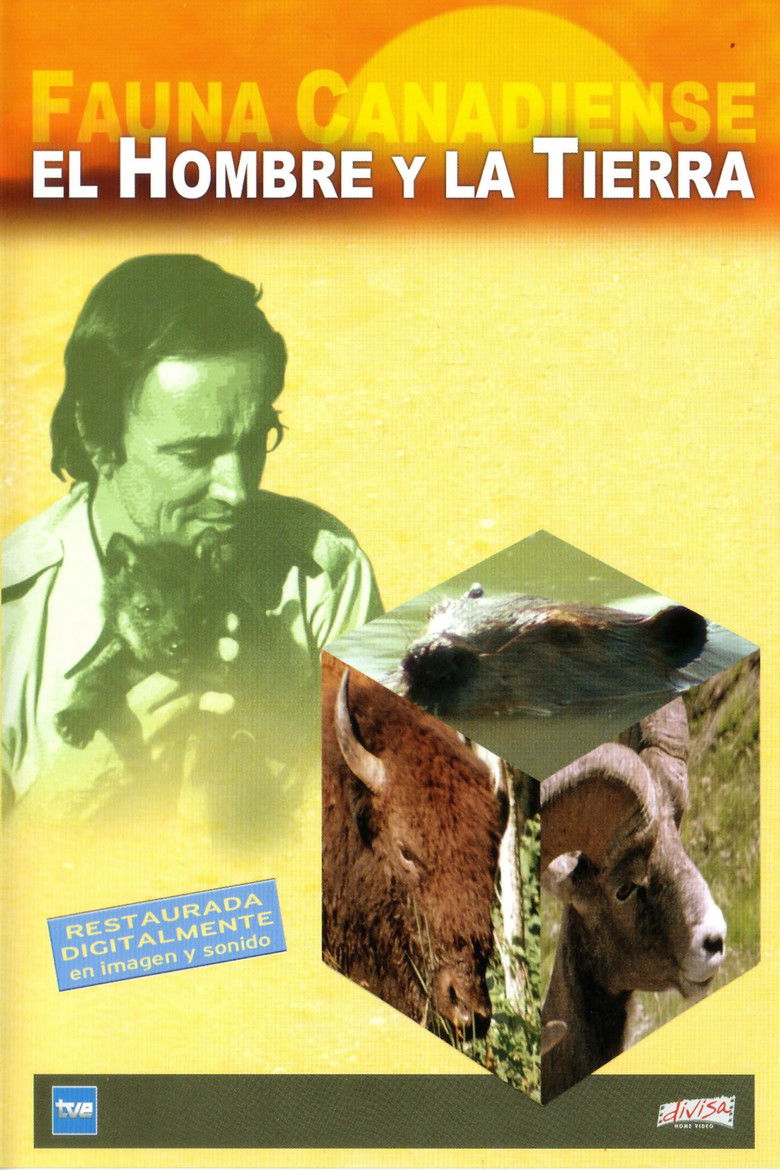
Canadian Series
Documentary on Canadian fauna

01. Nahanni
The first unit of the Man and the Earth crew explores the Canadian wilderness all the way to Virginia Falls. 250 kilometers across Nahanni National Park. Over three stages they travel to the falls, accompanied by an invasion of mosquitoes, for which they are equipped with special masks and gloves to ensure the expedition does not fail.

02. The Frozen Cemetery
In 1971, a deep frozen cavern was discovered on a cliff face in Nahanni National Park, which was named the Valeria Grotto. At a depth of eight hundred meters, perfectly preserved skeletons were found.
03. Kluane
On July 4, 1979, the first Canadian expedition begins to produce the first report from the interior of Kluane Park. After spending the night at a lake, the crew sets out to reach the high glaciers, the main attraction of the area.

04. Operation Peregrine
The peregrine falcon is one of Félix Rodríguez de la Fuente's favorite animals, and he dedicated an episode of the Canadian shoot to filming this center where more than 300 birds have been bred.

05. The Beaver Lake
After traveling more than 50,000 kilometers across Canada, the Man and the Earth crew goes in search of beavers to observe their habits. A rodent that appears on the national flag's coat of arms alongside a maple leaf. Beavers are known for their ability to fell and cut trees with their teeth.

06. Great Canadian Wildlife I
In Canada, extremely favorable circumstances have come together for the survival of wildlife. First, colonization came late. The harsh winter climate limited the activities of hunters and trappers. The government enacted legal measures to protect wildlife.

07. Great Canadian Wildlife II
The Man and the Earth crew travels to the Canadian national park of Pacific Rim, on Vancouver Island, to film the gray whales, which today attract great attention from scientists and wildlife and nature conservationists alike.

08. Operation Caribou
One of the most important animals of northern Canada is the caribou. This large cervid, which feeds mainly on lichens, was the foundation of survival for the Inuit and the Indians of the great north.

09. Operation Rescue
In the last days of autumn, nearly all the lakes, rivers, and lagoons of northern Canada are already frozen over. As a result, some American white-tailed eagles, or bald eagles, are unable to fish to feed themselves.

10. Winter in Canada
In the month of November, a large part of Canada is covered in snow. The Man and the Earth crew, flying through a snowstorm, travels to the Arctic tundra to film the winter migration of the caribou and the bison heading toward more sheltered prairies.

11. The Trapper
The trappers of Canada have become famous worldwide through the stories of novelist Jack London: their primitive life in the wild territories, their knowledge of the wildlife and climate, their independence, and their hospitality.
12. Adventure in Canada
The adventure through Nahanni National Park begins with a descent down this river aboard two powerful steel boats with jet engines, the only safe means of reaching the famous Virginia Falls.

13. Iditarod. 1,000 Miles on Ice I
This time, Man and the Earth travels to a remote corner of the planet. Alaska awaits us, but it is not its legendary bears or its bald eagles that our cameras are after. It is a sled dog race covering half the peninsula in the middle of winter.

14. Iditarod. 1,000 Miles on Ice II
In the first part of the thousand-mile race, we saw how the start and each stage are organized. Here we will see how Félix follows the arrival of the first finishers. Man and the Earth will cover the stages with images of spectacular beauty captured by two cameras.